
APPROACH TO CRIMINOLOGICAL COMPLEXITY: BE AN EXPERT IN CRIMINOLOGY

2024 | Maria Barrera
Until today, those who try to explain crime and violence have done so in terms of man in various disciplinary theories, without achieving the comprehensive complexity of criminogenic behavior. This leads us to continue in human fragmentation, fragmentation of knowledge, and in the perpetual conflict that prevents us from understanding the root causes and effectively preventing violence and criminality...
In the 18th century, Lombrosian criminology was born. Since then, the world has changed, consequently, human behavior, and with it the social sciences.
Fragmentation has been the way that we have found and that has mostly predominated in humanity, in order to try to understand how the world, countries, societies, systems, groups, human beings work. Everything in the material-human world that we live in is a construction of the same human being, science is too, we have decided to build it through experimentation, direct observation (the deeper, the greater understanding, the more questions, the better answers), the quantifiable. , what can be qualified, and the theory that arises from the above.
We learned to know, to try to understand from each of the parts that make up a system (human body, social group, countries, planets), and this is thanks to science, starting with discards and its scientific research method.
Descartes came to dialogue with the church to leave the research, study and search for understanding of the observable to science, leaving the internal part of the human being (soul, spirit) to religion, curiously the most complex part of man. and that by leaving out the investigation of being from science, it fragments the understanding and, consequently, the discovery of the path to human integrity.
Integrative research (connections) through criminology leads us to see discordances in the way of life of the man who commits criminogenic, risky, violent or deviant behaviors, these behaviors are motivated by a fragmentation of his being, and consequently , an internal disconnection between their internal-external worlds, this disconnection triggers conflicts that can either aggravate or can be minimized according to the external internal reinforcements that arise from how they internalize their worlds, and even more complex, from how they achieve or not, integrate them.
Here we are situated in Complexity, but also in consciousness ; since we are integrating an understanding that arises from experience, observance, experimentation and understanding, and bringing it to the matter in which we live most of our lives, the majority of human beings.

That is, consciousness occurs through the search for knowledge, and its integration, its internalization. Their internalization involves taking them to our material reality. It is downloading information, having understood it in depth, applying it and questioning it again in order to integrate new knowledge, reaching another level of consciousness once we integrate, internalize and return to material reality. This endless process leads to consciousness and this in turn, to humanity's own complexity.
The true reality (not fragmented) is complex, and arises from knowing from the beginning, about the existence of human fragmentation, having consciously experienced and understood it.
This reality cannot be approached from a single discipline; interdiscipline is required to achieve the objective, not only of understanding in depth, but also of trying to avoid human fragmentation and the search for integrity with a view to conscious human evolution. This is how it is prevented, this is how criminology contributes to conscious human transformation, to a more integrated humanity, less criminogenic and more harmonious and evolutionary. This is how the criminological purpose is achieved.
Linear knowledge is not functional, since it cannot see the relationships beyond the cause and effect (consequence), the science of complexity integrated into criminology detonates a vision that allows generating investigations, experiences and answers that surpass the knowledge that even Today we have criminology, managing to integrate knowledge, leaving aside the fragmented knowledge scheme that comes from the 18th century.
Until today, those who try to explain crime and violence have done so in terms of man in various disciplinary theories, without achieving the comprehensive complexity of criminogenic behavior. This leads us to continue in human fragmentation, fragmentation of knowledge, and in the perpetual conflict that prevents us from understanding the root causes and effectively preventing violence and criminality...
In the 18th century, Lombrosian criminology was born. Since then, the world has changed, consequently, human behavior, and with it the social sciences.
Fragmentation has been the way that we have found and that has mostly predominated in humanity, in order to try to understand how the world, countries, societies, systems, groups, human beings work. Everything in the material-human world that we live in is a construction of the same human being, science is too, we have decided to build it through experimentation, direct observation (the deeper, the greater understanding, the more questions, the better answers), the quantifiable. , what can be qualified, and the theory that arises from the above.
We learned to know, to try to understand from each of the parts that make up a system (human body, social group, countries, planets), and this is thanks to science, starting with discards and its scientific research method.
Descartes came to dialogue with the church to leave the research, study and search for understanding of the observable to science, leaving the internal part of the human being (soul, spirit) to religion, curiously the most complex part of man. and that by leaving out the investigation of being from science, it fragments the understanding and, consequently, the discovery of the path to human integrity.
Integrative research (connections) through criminology leads us to see discordances in the way of life of the man who commits criminogenic, risky, violent or deviant behaviors, these behaviors are motivated by a fragmentation of his being, and consequently , an internal disconnection between their internal-external worlds, this disconnection triggers conflicts that can either aggravate or can be minimized according to the external internal reinforcements that arise from how they internalize their worlds, and even more complex, from how they achieve or not, integrate them.
Here we are situated in Complexity, but also in consciousness ; since we are integrating an understanding that arises from experience, observance, experimentation and understanding, and bringing it to the matter in which we live most of our lives, the majority of human beings.
That is, consciousness occurs through the search for knowledge, and its integration, its internalization. Their internalization involves taking them to our material reality. It is downloading information, having understood it in depth, applying it and questioning it again in order to integrate new knowledge, reaching another level of consciousness once we integrate, internalize and return to material reality. This endless process leads to consciousness and this in turn, to humanity's own complexity.
The true reality (not fragmented) is complex, and arises from knowing from the beginning, about the existence of human fragmentation, having consciously experienced and understood it.
This reality cannot be approached from a single discipline; interdiscipline is required to achieve the objective, not only of understanding in depth, but also of trying to avoid human fragmentation and the search for integrity with a view to conscious human evolution. This is how it is prevented, this is how criminology contributes to conscious human transformation, to a more integrated humanity, less criminogenic and more harmonious and evolutionary. This is how the criminological purpose is achieved.
Linear knowledge is not functional, since it cannot see the relationships beyond the cause and effect (consequence), the science of complexity integrated into criminology detonates a vision that allows generating investigations, experiences and answers that surpass the knowledge that even Today we have criminology, managing to integrate knowledge, leaving aside the fragmented knowledge scheme that comes from the 18th century.
Criminology has evolved, it has been transformed through those who are in the field of action interacting directly with those who manifest violent, criminogenic, criminal behavior.
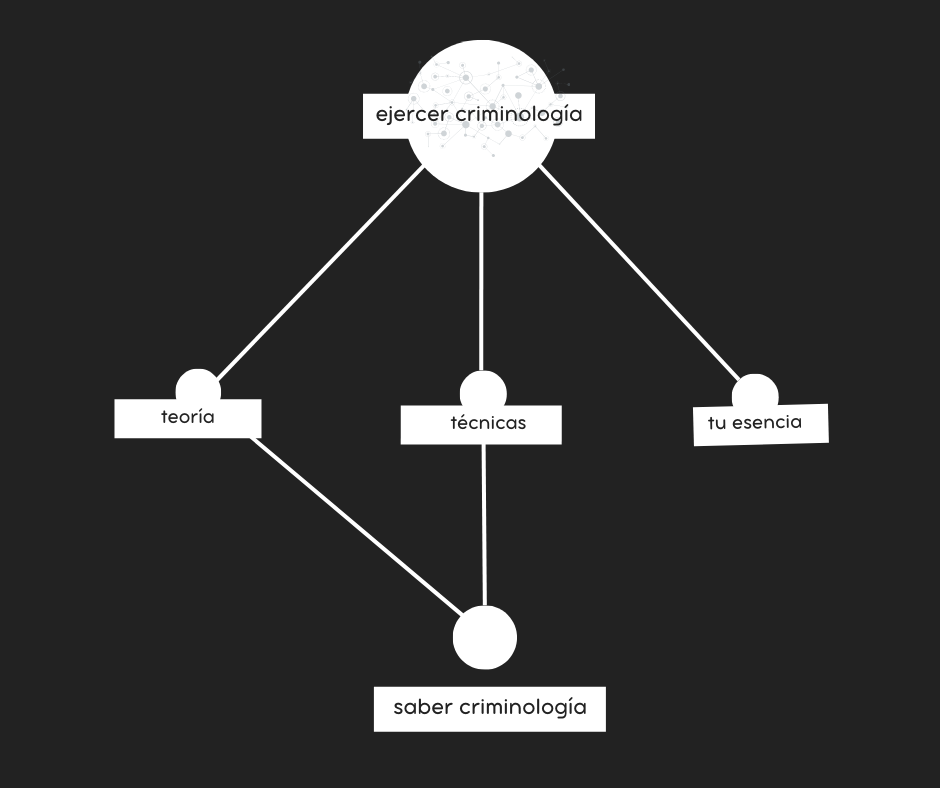
Here the door opens to a deep understanding of criminology from the criminological eye and human complexity. Whoever practices Criminology in its purest state must carry with them a series of master skills so as not to get lost along the way.
I will talk to you about it in the next criminological writing.
SEE YOU SOON!


Comments