
Criminological Complexity: its why and what for

2024 | Maria Barrera
Fragmentation, Integration, Interdiscipline, Consciousness, Unidiscipline, Complexity, Purpose; They are terms with deep meaning seen from Criminology.
I share here a brief note of its importance in criminological professional practice.
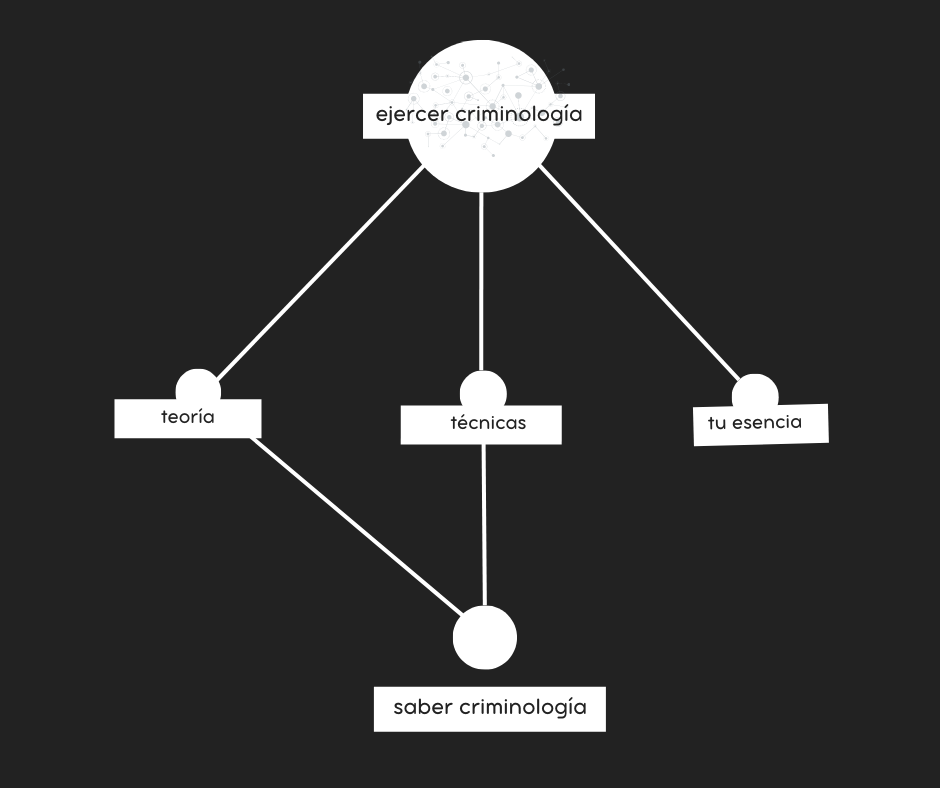
It is important that everything is integrated together, after understanding the why and why of its fragmentation.
The purpose of giving this knowledge is so that you can identify. Maybe you are looking for it, or maybe you are not, and maybe you genuinely identify it as necessary for your life and your profession.
Fragmentation has been the way that we have found and that has mostly predominated in humanity, in order to try to understand how the world, countries, societies, systems, groups, human beings work. Everything in the material-human world that we live in is a construction of the same human being, science is too, we have decided to build it through experimentation, direct observation (the deeper, the greater understanding, the more questions, the better answers), the quantifiable. , what can be qualified, and the theory that arises from the above.
We learned to know, to try to understand from each of the parts that make up a system (human body, social group, countries, planets), and this is thanks to science, starting with discards and its scientific research method.
Descartes came to dialogue with the church to leave the research, study and search for understanding of the observable to science, leaving the internal part of the human being (soul, spirit) to religion, curiously the most complex part of man. and that by leaving out the investigation of being from science, it fragments the understanding and consequently the discovery of the path to human integrity.
Integrative research (connections) through criminology leads us to see discordances in the way of life of the man who commits criminogenic, risky, violent or deviant behaviors, these behaviors are motivated by a fragmentation of his being, and consequently , an internal disconnection between their internal-external worlds, this disconnection triggers conflicts that can either aggravate or can be minimized according to the external internal reinforcements that arise from how they internalize their worlds, and even more complex, from how they achieve or not, integrate them.
Here we are situated in Complexity, but also in consciousness; since we are integrating an understanding that arises from experience, observance, experimentation and understanding, and bringing it to the matter in which we live most of our lives, the majority of human beings.
That is, consciousness occurs through the search for knowledge, and its integration, its internalization. Their internalization involves taking them to our material reality. It is downloading information, having understood it in depth, applying it and questioning it again in order to integrate new knowledge, reaching another level of consciousness once we integrate, internalize and return to material reality. This endless process leads to consciousness and this in turn, to humanity's own complexity.
La verdadera realidad(no fragmentada) es compleja, y surge de saber de inicio, sobre la existencia de la fragmentación humana habiéndola experimentado y comprendido a consciencia. 
This reality cannot be approached from a single discipline; interdiscipline is required to achieve the objective, not only of understanding in depth, but also of trying to avoid human fragmentation and the search for integrity with a view to conscious human evolution . This is how it is prevented, this is how criminology contributes to conscious human transformation, to a more integrated humanity, less criminogenic and more harmonious and evolutionary. This is how the criminological purpose is achieved .
See you in future live sessions going deeper into the topic.
See you soon!
Have you already subscribed? I have something for you every week.


Comments